
Interview podcasts thrive on chemistry, curiosity, and conversation. But how often do popular hosts actually let their guests finish speaking?
A new analysis from Podranker attempts to answer that question by ranking 20 popular interview podcasts based on how frequently hosts interrupt their guests. Using speaker diarization and audio analysis tools, the study measured instances where hosts talked over or cut off interviewees, creating a data-driven look at conversational dynamics across shows.
How the Ranking Was Created
Podranker analyzed multiple episodes from each of the 20 podcasts using automated speech detection. The system identified speaker turns and flagged interruptions — moments when a host began speaking before the guest had finished.
Rather than judging quality or intent, the ranking focuses purely on measurable interruption frequency. It doesn’t attempt to determine whether interruptions were helpful clarifications, enthusiastic reactions, or disruptive cutoffs — only that they occurred.
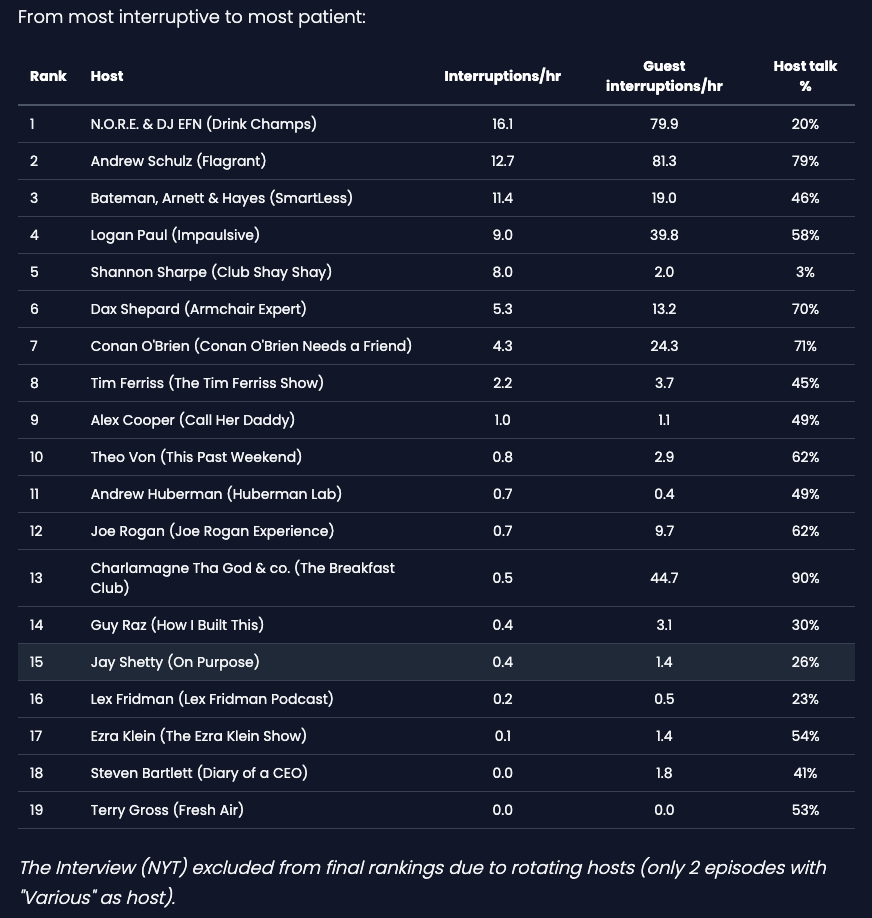
This quantitative approach offers a rare, objective lens into podcast hosting styles.
Big Differences in Interview Style
The results show striking variation between hosts.
At one end of the spectrum, some personalities logged high interruption counts in sampled episodes — in one example cited by Podranker, a host recorded 16 interruptions in the analyzed content.
At the other end, veteran broadcaster Terry Gross reportedly did not interrupt once in the episodes reviewed, highlighting a dramatically different conversational philosophy.
The ranking underscores that interruption frequency isn’t uniform across podcasting. Instead, it reflects deeper stylistic choices about pacing, authority, and energy.
Why Interruptions Matter
Interruptions can shape how a podcast feels to listeners.
Frequent interjections may create a fast-paced, energetic dynamic. In comedy, sports, or debate-oriented shows, overlapping dialogue can feel natural and engaging. Some audiences expect rapid-fire exchanges and spontaneous reactions.
However, in long-form interviews or educational content, interruptions can limit a guest’s ability to fully articulate ideas. For listeners seeking depth and insight, constant interjections may feel distracting or even disrespectful.
In short, interruption style contributes directly to a show’s tone and brand identity.
What This Means for Podcast Creators
For creators producing interview-style podcasts, the ranking offers a useful reflection point.
Hosting style is often instinctive, but measurable patterns like interruption frequency can reveal habits that may not be obvious in the moment. Reviewing raw recordings or analyzing transcripts can help hosts evaluate whether they’re guiding conversations or unintentionally dominating them.
Creators may also consider:
- Whether interruptions clarify or derail discussion
- How editing affects perceived pacing
- Whether guests have sufficient space to complete complex thoughts
- How audience expectations align with conversational style
For business podcasts, branded shows, and educational programs in particular, clarity and guest authority often matter more than host personality.
The Data-Driven Future of Podcast Analysis
Podranker’s ranking highlights a broader trend in podcasting: the increasing use of data to analyze content beyond download numbers. Speech analysis tools now allow measurement of talk time, pacing, sentiment, and conversational structure.
For creators and networks, this type of insight could inform host coaching, production decisions, and even show development strategies.
As podcasting matures, metrics about how conversations unfold may become as important as audience growth numbers.
A Reminder: Style Is a Choice
Interruptions are not inherently good or bad. They reflect creative decisions about how a show should feel.
Some of the most popular podcasts thrive on chaotic, overlapping dialogue. Others succeed because they provide calm, uninterrupted space for thoughtful discussion.
The key takeaway from Podranker’s ranking isn’t which host interrupts most — it’s that conversational dynamics shape listener experience more than many creators realize.
For interview-based podcasts, how often a host speaks may matter just as much as what they say.
More about podcast hosts:
 Staff Report
 Dan Craft
 Dan Craft