

Podcasting has long been celebrated for its low barrier to entry and its democratizing potential. But popularity among listeners doesn’t necessarily translate to long-term success for creators themselves.
The newly published The Creators 2025 report — an expanded follow‑up to Sounds Profitable’s original creator study — provides a comprehensive look at the people behind the mic (and increasingly, the camera), revealing surprising trends in who creates podcasts, how they work, and why many stop producing entirely.
Broad Adoption, Yet High Drop‑off
One of the most striking findings of The Creators 2025 study is the widespread experimentation with podcast creation — yet a persistent challenge in keeping creators engaged long term.
According to the research, nearly one in six Americans who listen to podcasts have tried creating one themselves, showing that creator ambitions remain high. But for roughly every three people who start a show, only one keeps going, with the remaining two either abandoning projects entirely or fading out over time.
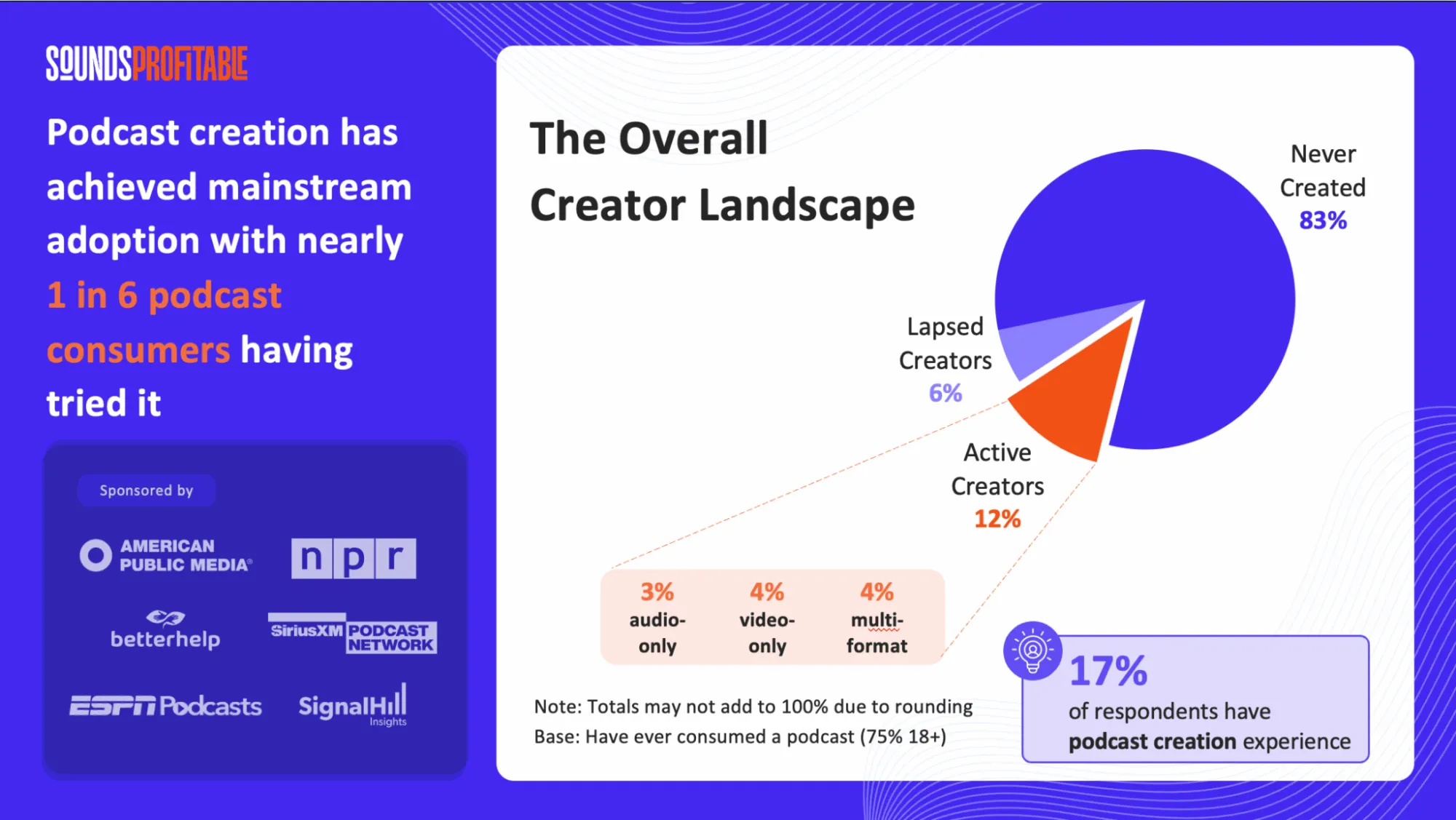
Sounds Profitable’s data suggests this “creator fade” isn’t just about individual podcasts ending — it points to people leaving the medium entirely, not just shelving one series and starting another. This distinction matters because it shifts the focus from treating the issue as “podfade” (a show ending) to addressing broader barriers that discourage sustained creative participation.
Who Today’s Creators Really Are
The Creators 2025 digs into the demographics of podcast creators, showing a more diverse ecosystem than industry assumptions often reflect. While traditional narratives might assume a homogeneous creator base, the report finds significant variation across gender, age, race/ethnicity, and LGBTQ+ identity — and importantly, that multicultural creators often demonstrate engagement levels up to twice the industry average.
This pattern of higher engagement among diverse creators underscores a crucial insight: audience and creator diversity may be driving deeper connections and stronger listener loyalty in ways that legacy industry narratives don’t fully capture. In an increasingly competitive attention economy, such engagement signals both market opportunity and creative influence.
The Shift Beyond Audio‑Only
Another key theme in The Creators 2025 report is that podcasting is no longer strictly an audio‑only medium. While sound remains central, a growing share of creators now incorporate video or hybrid formats — including video podcasts, clips for social media, or embedded livestreams — reflecting broader consumption shifts shaped by platforms like YouTube and TikTok.
This trend challenges conventional definitions of podcasting and signals a multimedia future where creators blend formats to meet audience expectations. The expansion into video also taps into larger patterns evident in other Sounds Profitable research, where shifts in smart TV and YouTube usage point to changing ways listeners engage with podcast content.
Why Many Creators Exit Podcasting
One of the most important contributions of The Creators 2025 study is its emphasis on why many creators stop producing content. The report associates high churn with a mix of structural and practical challenges: inconsistent monetization, burnout from production demands, and a lack of sustainable support systems.
This aligns with broader industry observations that while podcasting remains appealing, the realities of consistent content production — planning, recording, editing, and promotion — can be difficult to maintain alongside other responsibilities.
Instead of framing the issue simply as “podfade,” Sounds Profitable highlights “creator fade” — the point at which individuals disengage from creating altogether — as a far more consequential trend. By reframing the problem this way, the research urges the industry to focus not just on audience growth but on the factors that keep creators motivated and supported.
Implications for Platforms, Publishers, and Advertisers
For companies that rely on podcasting for growth — including platforms, publishers, and advertisers — the report offers a strategic mirror. Growth in listener numbers does not automatically translate to a thriving creator base.
A deeper understanding of creator motivations, format preferences, and long‑term barriers is vital for building tools, monetization strategies, and communities that support creators at every stage.
For example, monetization challenges remain significant: many creators start with high hopes for revenue through advertising or sponsorships, only to find that inconsistent income makes long-term commitments difficult. Better support structures — such as streamlined ad tech, creator funds, or more predictable revenue models — could help retain creative talent and reduce churn.
What the Future Holds
The Creators 2025 doesn’t just catalog who is creating today — it also points toward the future of the medium. The diversification of formats, higher engagement among underrepresented creators, and the reality of creator burnout all offer clues about where the industry must invest next.
Supporting multimedia creation workflows, fostering sustainable monetization, and building networks of peer support could help reduce creator fade and strengthen the ecosystem overall.
Sounds Profitable’s full report and accompanying data tools provide a foundation for anyone looking to understand creator behavior in podcasting today — not just listeners, but the people shaping the medium’s evolution.
For publishers, advertisers, and platform builders, this research is a call to action: invest in creators, reduce friction, and build podcasting systems that nurture participation over the long term.